


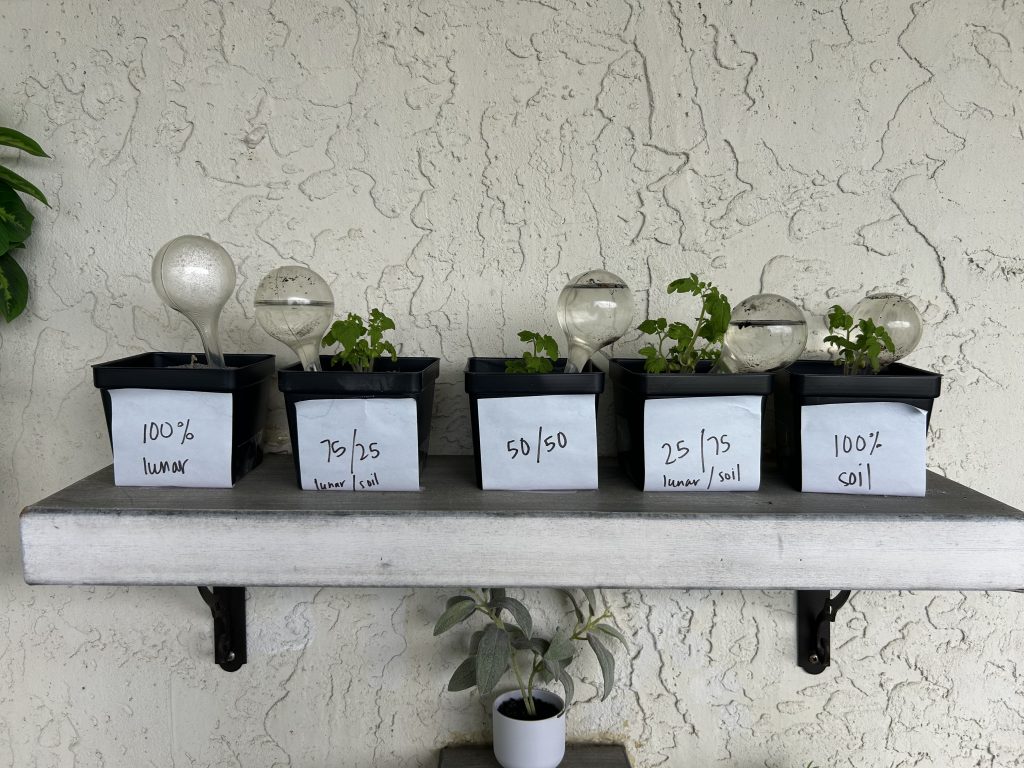
Institute of Competition Sciences Plant the Moon Challenge builds on a long-standing history of space agriculture, inspired by real research taking place through NASA’s Artemis program.
The first plant ever grown in space by humankind was cultivated aboard the Soviet Salyut 4 space station a little over a half century ago. Scallions, or the little green garnishes you may commonly see on potato dishes, were grown using a grow-lamp greenhouse called the Oasis 1M. Cosmonauts aboard Salyut 4 successfully grew 20 cm long scallions and ended up eating them as part of a meal for a crew member’s birthday (Guinness World Records, n.d.). What a way to celebrate with space-grown onions!
Today, researchers are asking much bigger questions. As humans prepare for missions to the Moon and eventually Mars, scientists must determine how future crews will produce food far from Earth. While astronauts can bring food with them on shorter missions, carrying years’ worth of supplies for long-duration exploration becomes increasingly difficult. Growing crops beyond Earth could become a critical part of future space travel, and aligns both with the Artemis objectives and the Plant the Moon Challenge
During the PTMC, participants have the opportunity to contribute to real-world research questions surrounding space agriculture.
The Challenge asks participants an important question: Can we grow crops in lunar and Martian regolith simulant? Regolith is the layer of dust, rock fragments, and other loose material that covers the surface of the Moon and Mars. Challenge participants investigate whether crops can grow in these environments and whether growing systems can be sustained long enough to help keep future crews fed during complex missions.
Humans rely on food for nutrients, vitamins, energy production, and overall health. We all know how essential agriculture is here at home, but what about 140 million miles away? As you probably guessed, the same concept applies. If humans are going to live and work on the Moon or someday travel to Mars, food production will be just as important there as it is on Earth.
Many people may not immediately realize the vastly strong connection between space exploration and agriculture, which is understandable given how different the industries appear at first glance. However, Plant the Moon Challenge highlights another important connection: the relationship between STEM education and rural communities.
According to the National Library of Medicine, the underrepresentation of individuals from rural communities contributes to a cultural divide between rural America and the scientific community at all levels (O’Neal & Perkins, 2021).
Students in many rural communities typically have access to fewer STEM courses, extracurricular programs, and advanced learning opportunities compared to their urban and suburban peers. Despite these challenges, rural communities rely heavily on science-related industries including agriculture, forestry, mining, and manufacturing. Research has also shown that students from rural and small-town communities are less likely to major in STEM fields in postsecondary education than suburban students (Saw & Agger, 2021).
However, because of these existing connections between rural industries and STEM, many students in rural areas are already implementing STEM concepts in their everyday lives, even though they may not realize it!
While the challenge focuses on growing crops for future lunar and Martian missions, its impact reaches beyond space exploration. The PTMC serves as an entry point into scientific research, experimentation, and problem-solving for students from all communities, allowing them to apply their unique perspectives and skills and connect with the global scientific community.
The Institute of Competition Sciences has partnered with the National FFA Organization to bring the Plant the Moon Challenge and Build the Moon Challenge to the National FFA’s network of more than one million students and educators and bridge the gap between rural communities and STEM education.
The future of space exploration will require scientists, engineers, farmers, educators, and innovators with a wide range of expertise, interests, and technical backgrounds.
Are you ready to Plant the Moon? Registration is now open through January 2027. Space Grant applications are open from October 26, 2026 through December 4, 2026. Learn more or get started at PlantTheMoon.com.